Wellness Data
Early Development Instrument
The Early Development Instrument (EDI) was used across the NWT for the first time in March 2012 to assess children’s developmental readiness for school learning prior to Grade 1 entry. The EDI is similar to a census, reporting findings at the population level. It is not a diagnostic tool and does not report findings on individual children. The EDI provides an assessment of the first five years of early childhood development with a snapshot of groups of children’s developmental health in five areas:
- Physical health and well-being;
- Social competence;
- Emotional maturity;
- Language and cognitive development; and
- Communication skills and general knowledge.
Kindergarten teachers complete the EDI surveys in February-March of the Kindergarten school year. Annually collected EDI data provides information to guide decision-making, monitor trends and measure the impacts of changes to programs and services provided for children in the early years. The five domains of early childhood development measured by the EDI are predictive of school outcomes, including academic achievement, and so the data is also used by schools in planning for programming and supports for children in Kindergarten through Grade 3 years.
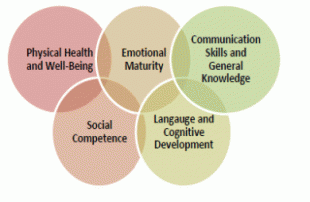
Physical Health & Well‐Being ‐ includes gross and fine motor skills ‐ e.g., holding a pencil, running on the playground, motor coordination, and adequate energy levels for classroom activities.
Social Competence ‐ includes curiosity about the world, eagerness to try new experiences, knowledge of standards of acceptable behaviour in a public place, ability to control own behaviour, cooperation with others, following rules, and ability to play and work with other children.
Emotional Maturity ‐ includes ability to reflect before acting, a balance between too fearful and too impulsive, and ability to deal with feelings at the age-appropriate level, and empathic response to other people's feelings.
Language and Cognitive Development ‐ includes reading awareness, age appropriate reading, writing and numeracy skills, board games, and ability to understand similarities and differences, and to recite back specific pieces of information from memory.
Communication Skills and General Knowledge ‐ includes skills to communicate needs and wants in socially appropriate ways, symbolic use of language, story‐telling, and age appropriate knowledge about the life and world around
The information from the EDI is used to guide decision making for the early years and to guide schools in program planning for children in the primary grades.
Middle Years Development Instrument
The Middle Years Development Instrument (MDI) is a questionnaire that is completed by elementary students in Grade 4 and Grade 7. It measures five areas of development (physical health and well-being, connectedness, social emotional development, school experiences and use of after-school time), which are strongly connected to well-being, health, and academic achievement. There are two indexes that use data from the MDI questionnaire – the Well-Being Index and the Assets Index. The Well-Being Index combines five measures from the MDI:
- Optimism
- Self-esteem
- Happiness
- Absence of sadness
- General health
Depending on how many “positive” and “negative” responses children report in the five areas of well-being, they have a result that is either “thriving,” “medium to high well-being,” or “low well-being.”
The Department of Education, Culture and Employment (ECE) and schools evaluate MDI results annually to assess health and well-being trends of students in those grades. The expectation is that, as the NWT Junior Kindergarten to Grade –12 (JK-12) school system becomes better able to reflect the cultures of the NWT and support students to flourish as capable and healthy persons, MDI “thriving” scores should increase.
It is important to note that MDI “thriving” scores are affected by more than just students’ school experiences. Students’ lives and experiences outside of school also affect their sense of well-being and have an effect on how students feel when they arrive at school.
It is important to note that MDI “thriving” scores are affected by more than just students’ school experiences. Students’ lives and experiences outside of school also affect their sense of well-being and have an effect on how students feel when they arrive at school.
This data helps to inform the annual Junior Kindergarten to Grade 12 Performance Measures reports, which looks at the current state of the NWT education system.